In-House Product
·In Development
Nook — Hostel & PG Management Platform
A modern hostel and PG management platform designed to simplify resident management, admissions, bookings, bed allocation and financial operations through one unified system.
- Nature
- In-House SaaS Product
- Launch Region
- Pune, Maharashtra
- Current Status
- Phase 2 Completed
- Domain
- trynook.in
An in-house SaaS platform engineered to modernize hostel and PG operations.
Nook is an in-house software product being actively designed, engineered, and incubated by the Forge team. Unlike client engagements where we build for an external stakeholder's brief, Nook represents our own commitment to solving a pervasive, high-friction operational problem from first principles.
Across India—and specifically in major student and technology corridors like Pune—hostels and paying-guest (PG) accommodations manage hundreds of beds, frequent tenant churn, monthly rent collections, and daily maintenance requests. Yet the vast majority still rely on paper registers, fragmented WhatsApp chats, and ad-hoc UPI screenshots.
Nook replaces that operational sprawl with a single unified platform. It connects physical inventory (campus, building, floor, room, and bed) directly to resident lifecycles, booking workflows, and financial reconciliations. We are currently building and validating Nook with hostel operators in Pune, establishing a rock-solid operational engine before scaling broader distribution.
Development Status Notice
Active In-House Engineering · Phase 2 Complete
Nook is presented here as an active product under development. Foundational architecture and inventory APIs are complete; resident lifecycle and billing modules are actively in development.
Hostels run multi-lakh monthly turnover on memory, paper registers, and WhatsApp.
Operational bottlenecks compound as soon as a property scales beyond a single floor. Without a single source of truth, daily administration consumes time that should go toward student safety, facility maintenance, and business growth.
Fragmented resident records
Identity proofs, permanent addresses, college/work details, parent contacts, and emergency information are scattered across paper registers, Google Forms, and local folders. When an urgent situation occurs, locating verified information takes minutes of frantic searching.
Manual booking & bed allocation
Bed assignments are managed on notebooks or informal memory. Double-booking rooms during peak admission seasons, accidental promises of the same bed to two incoming residents, and unrecorded room swaps create frequent disputes and confusion.
Difficulty tracking occupancy
Hostel owners operating multiple floors or separate buildings cannot see live, reliable vacancy figures at a glance. They cannot distinguish between occupied beds, reserved beds awaiting check-in, and beds out of service for maintenance.
Disorganized rent & payment records
Payments arrive through multiple channels—cash, bank transfers, and direct UPI—without centralized matching. Security deposits, utility deductions, and overdue dues are tracked on spreadsheets, leading to lost revenue and tense arguments during check-out.
Lack of centralized hostel operations
Wardens, facility managers, and owners work in operational silos. Maintenance complaints (water, Wi-Fi, electrical) get lost in messaging group noise, leaving residents frustrated and owners blind to recurring operational costs.
A unified operating system for hostel and PG operations.
Nook consolidates physical property management, resident lifecycles, and financial records into one coherent software ecosystem. To maintain complete technical integrity, we clearly demarcate what is already built from what is currently on the development roadmap.
Property & Inventory Management
A complete structural model of physical properties: Organization → Campus → Building → Floor → Room → Bed unit.
Implemented Capabilities:
- Room categorizations (single, double, triple, 4-sharing) with custom amenity tags
- Granular bed-level status tracking: Available, Reserved, Occupied, Maintenance
- Real-time capacity calculations and multi-floor occupancy visibility
- Atomic inventory operations preventing double-assignment or inconsistent state
Resident Management
A centralized digital dossier for every resident, replacing loose paper forms and unverified phone contacts.
Planned Capabilities:
- KYC document storage (Aadhaar, student ID, employment verification)
- Structured parent, guardian, and emergency contact registry
- Resident stay history, room change logs, and disciplinary notes
- Communication logs and critical announcements
Booking & Admissions
A structured admission pipeline designed to handle high-velocity student and seasonal intake.
Planned Capabilities:
- Lead and enquiry management for prospective students and professionals
- Time-bounded bed reservation holds with advance token tracking
- Digital admission agreements with clear rules and terms acceptance
- Automated conversion from prospective enquiry to confirmed admission
Check-in & Check-out
Formal digital protocols for the beginning and conclusion of every resident stay.
Planned Capabilities:
- Digital check-in inspection checklists (room condition, key handover, inventory)
- Security deposit receipting and condition logging at move-in
- Exit clearance workflows ensuring all pending dues and assets are cleared
- Deposit refund processing and structured departure documentation
Finance & Billing
Transparent ledger and automated billing designed for recurring hostel rent cycles.
Planned Capabilities:
- Automated monthly rent invoice generation tailored to contract start dates
- Variable utility and food/mess charge additions
- Multi-mode payment logging (UPI, bank transfer, cash) with ledger reconciliation
- Automated payment receipts and overdue reminder notifications
Hostel Operations & Maintenance
Everyday operational control for wardens, property managers, and facility owners.
Planned Capabilities:
- Resident maintenance issue ticketing (Wi-Fi, plumbing, electrical, cleaning)
- Ticket assignment, vendor tracking, and resolution timestamps
- Staff duty shifts and warden night-check logging
- Multi-property owner executive dashboard with operational health metrics
The implemented foundation: multi-tenant, type-safe, and modular.
Nook is engineered on an industrial-grade foundation. Rather than shipping a brittle monolith or premature microservices, we built a modular architecture where core domain models—security, multi-tenancy, and inventory—are fully implemented, benchmarked, and tested before building upper-level workflow modules.
Nook Core Runtime Pipeline
React + Vite Console
Type-safe management console with responsive room grid and floor-level view.
NestJS Security
HTTP-only session cookie guard, CSRF protection, and tenant context interceptor.
Modular Services
Auth, Tenancy, and Inventory business logic executing in isolated service scopes.
Prisma & Postgres
Tenant-scoped transactional queries, foreign key cascading, and ACID integrity.
NestJS Modular Backend
Structured domain boundaries with strict dependency injection, DTO validation, and centralized exception handling.
- Decoupled modules: AuthModule, TenancyModule, PropertyModule, InventoryModule
- Request validation pipelines using class-validator and class-transformer
- Consistent API response envelopes and structured logging
PostgreSQL & Prisma ORM
A normalized relational schema with full ACID compliance, foreign key cascades, and compile-time type safety.
- Hierarchical entity model: Organization → Property → Floor → Room → Bed
- Type-safe database queries generated automatically from Prisma schema
- Explicit transaction boundaries around inventory status changes to prevent race conditions
Session-based Authentication
Secure, stateful HTTP-only session management designed for web consoles without fragile client-side token storage.
- Cryptographically signed session identifiers stored in HTTP-only, SameSite cookies
- Role-Based Access Control (RBAC) protecting property and inventory mutations
- Defense against XSS and CSRF token extraction attacks
Tenant Isolation Security
Rigid multi-tenant data segmentation ensuring every hostel organization operates in a completely isolated silo.
- Every request is resolved and validated against the authenticated tenant context
- All Prisma read/write queries are strictly filtered by tenantId
- Zero cross-tenant data leakage verified by automated isolation test suites
Hierarchical Inventory APIs
High-concurrency REST endpoints governing physical rooms, bed allocations, and dynamic occupancy states.
- Atomic status transitions: Available → Reserved → Occupied → Maintenance
- Real-time capacity and occupancy metrics calculated at building and floor levels
- Comprehensive test coverage validating concurrent bed booking attempts
React & TypeScript Frontend
Fast, lightweight operator console engineered for daily administrative workflows and high data density.
- Component-driven design system tailored to high-density tabular and room-grid views
- Type-safe API contracts mirroring backend TypeScript interfaces
- Zero UI bloat: lightning-fast hot reloads and optimized production bundle
A precise, monoline visual identity built for product clarity.
Nook maintains its own distinct visual identity within the Forge portfolio. Engineered around closed vector geometries with zero font dependencies, the brand couples Midnight Indigo with high-contrast Nook Violet to establish an unmistakable, accessible presence in both software consoles and mobile apps.
Official Approved Palette
Midnight Indigo
#171338
Primary brand ground & wordmark
WCAG: 17.70:1 (AAA)
Nook Violet
#7657F6
Primary accent & app icon ground
WCAG: 4.70:1 (AA)
Soft Lavender
#F4F1FF
Surface & panel tint
WCAG: 15.90:1 (AAA)
Pure White
#FFFFFF
Reversed mark & card surface
WCAG: 17.70:1 (AAA)
Primary Text
#26233D
Body copy (not a logo colour)
WCAG: 14.20:1 (AAA)

Midnight Indigo (#171338) on White / Soft Lavender
Pure White (#FFFFFF) on Midnight Indigo

Lowercase 'n' monoline monogram

iOS/Android full-bleed Violet tile
- • x-height: 100 units
- • Stroke weight: 16 units
- • 45° symmetric 'k' arm & leg
- • Min clear space: 32 units
Nook Brand Board & System Geometry
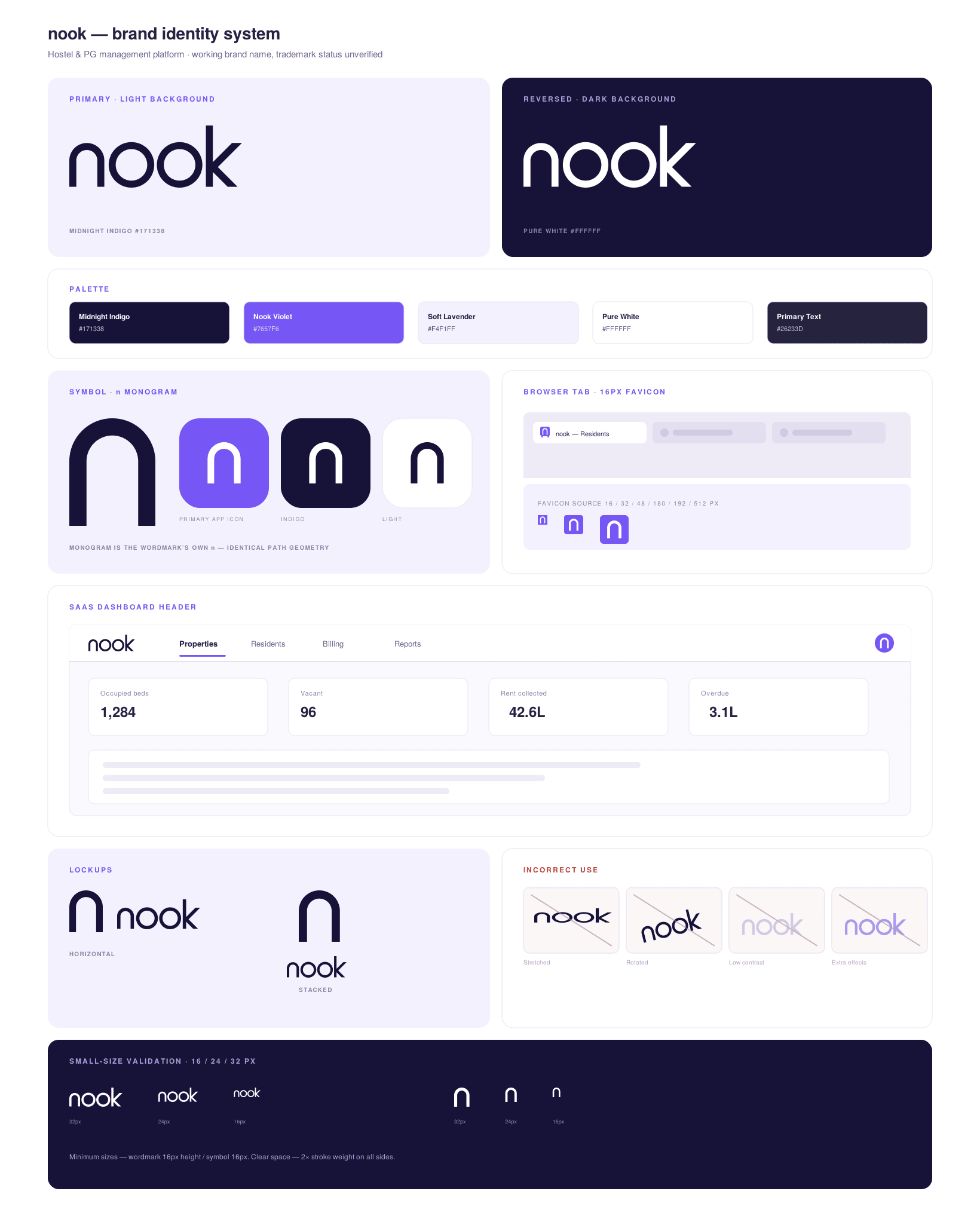
Official Nook Brand Board: Wordmark lockups, WCAG contrast verification, and UI tiles.
Phased engineering: verified foundations before feature expansion.
Rather than releasing half-baked prototypes, we track development against verified architectural milestones. In accordance with Forge engineering standards, we do not fabricate completion percentages or customer numbers—here is the exact, honest state of the Nook codebase today.
Phase 2 — Completed
- ✓
Authentication foundation
Stateful session-based auth with HTTP-only cookies, password hashing, and role checks.
- ✓
Multi-tenant security foundation
Organization context resolution, scoped Prisma queries, and data boundary validation.
- ✓
Property and inventory management foundation
Hierarchical entity model (Campus → Building → Floor → Room → Bed) with atomic availability transitions.
- ✓
Integration and isolation testing
Automated test suites validating concurrent allocations and cross-tenant data isolation.
Phase 3 — Planned / In Dev
- ○
Resident management
Digital dossiers, KYC identification files, parent contact registry, and emergency profiles.
- ○
Enquiry and sales
Lead pipeline, intake inquiry tracking, and automated prospect response workflows.
- ○
Booking and admissions
Time-bounded reservation holds, token collection, and digital admission agreements.
- ○
Check-in and check-out
Room condition handovers, asset inspection checklists, and deposit settlement clearance.
- ○
Finance and billing
Automated recurring rent invoices, utility charges, payment logs, and overdue alerts.
- ○
Operations and reporting
Maintenance ticket routing, warden shift logs, and multi-property occupancy dashboards.
Selected for resilience, developer ergonomics, and strict typing.
We avoid experimental frameworks and hype-driven dependencies. Every technology powering Nook was chosen for long-term operational stability and predictable maintenance.
Backend Services
Database & ORM
Frontend Console
Security & Testing
Initial focus on Pune hostel operations, scalable multi-hostel architecture.
Pune represents one of India's most active student and young-professional ecosystems. With major academic hubs like Kothrud, Karve Nagar, and Viman Nagar alongside IT corridors in Hinjawadi and Kharadi, the city hosts thousands of privately run hostels and paying-guest accommodations.
By focusing initial validation on Pune operators, the Forge team can observe real-world friction firsthand: how wardens manage night curfews, how desk managers handle admissions surges during college admission cycles in July and August, and how owners track overdue rent across multiple properties.
While initial workflows are grounded in Pune's daily operational reality, the software architecture is strictly cloud-native and multi-tenant. The underlying relational schema and tenant-isolation boundaries allow Nook to scale from an independent 30-bed hostel to institutional student-living operators managing thousands of beds across multiple cities.
Official Product Domain
trynook.in
Official web presence and future tenant onboarding portal for Nook.
Building websites and software your business actually runs on.
Whether you are building custom internal software, a high-converting web presence, or a scalable multi-tenant SaaS product like Nook—the Forge team delivers production-grade software engineered to last.